
Meiting Garments logo mark

Tech Pack Tips · 12 min read

Garment Measurement Tolerance Guide for Bulk Production

Quick Answer

A tolerance is not a second target measurement. It is the permitted variation around an approved target at a defined point of measure, product stage and inspection condition. A usable chart must protect fit-critical dimensions without pretending every POM can be measured with the same repeatability.

factoryBy EdmondBusiness & Production CoordinationTechnical review: Meiting Sample Development, Production & QC TeamPublished · Updated Editorial policy
Measurement ControlBuilt for apparel buyers preparing a production brief
01

Why one universal garment tolerance table fails

Garments are flexible three-dimensional products measured as two-dimensional surfaces. The reading can change with fabric relaxation, panel alignment, seam bulk, rib recovery, hood shape, wash treatment and how the operator places the tape. A blanket tolerance may be too wide for a neckline or decoration placement and unrealistically narrow for a curved hood or a washed hem. The correct question is not which tolerance number is standard for every garment. It is which points matter most, how repeatably they can be measured and what decision an out-of-tolerance result triggers.
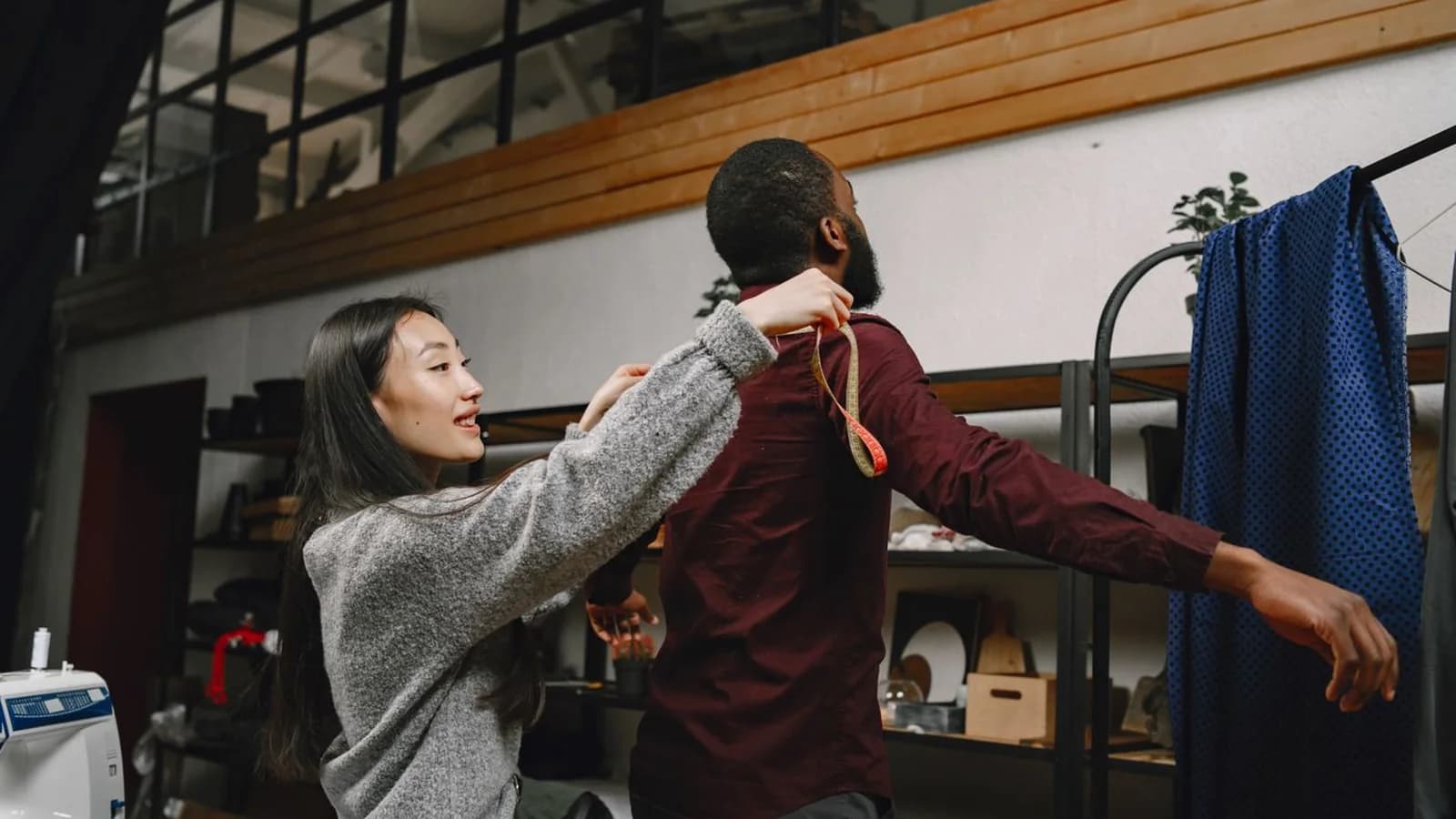
    Tailor measuring the shoulder of a man wearing a burgundy shirt during a menswear fitting
    Measurement control starts with a defined method, stable landmarks, and one approved product stage.
    02

    Define every point of measure before setting a tolerance

    A POM name such as chest, sleeve or body length is not enough. State the start and end landmarks, garment position, whether closures are open or closed, whether rib is relaxed, whether the tape follows a curve and whether the garment is smoothed without stretching. Use one diagram and one vocabulary across the tech pack, sample report and QC sheet. If two trained people cannot follow the instruction and obtain reasonably comparable readings, widening the tolerance hides a method problem rather than solving it.

    • Use unique POM codes and arrows on front, back and detail diagrams.
    • State half or full circumference and straight or curved measurement.
    • Define product preparation, closure state and surface tension.
    • Record the measurement unit and rounding convention.
    03

    Rank POMs by fit consequence

    Critical fit points directly affect whether the wearer can use the garment or whether the approved fit is preserved. Silhouette-control points shape the intended oversized, boxy, cropped or dropped-shoulder look. Placement points control the relationship between artwork, pocket, label, seam and garment landmarks. A buyer can assign a tighter control to a repeatable high-consequence point and a different control to a flexible or curved point. The purpose is not to make the table look strict. It is to protect the product decisions that matter most.

      04

      State the measurement stage

      Identify whether the chart applies to fabric-relaxed garments, before garment wash, after garment dye or wash, after pressing, or after a defined care cycle. A product can legitimately read differently at each stage. If the final commercial requirement applies after treatment, do not approve an untreated sample against that result without an explicit compensation and verification plan. Tie wash and shrinkage records to the same specification revision.

        05

        Build a usable tolerance chart in eight steps

        First approve the intended base-size fit. Next freeze the POM diagram and grade rules. Rank each POM by fit consequence, review how repeatably it can be measured, state the product stage, propose tolerance by POM, validate the chart through size-set or PP review and finally carry that chart into bulk QC. Keep target, tolerance and actual measurement in separate fields. Record every revision so an inspector can identify exactly which chart and garment condition control the decision.

          06

          Oversized T-shirt example

          For an oversized T-shirt, half chest, body length, shoulder width, sleeve length, neck opening and artwork placement do not create the same risk. Half chest and shoulder width shape the silhouette, while neck opening can affect wearability and recovery. Artwork position depends on stable garment landmarks. Review the relationship between these points rather than judging each reading in isolation. A chest within tolerance does not rescue a changed shoulder line or misplaced print that alters the approved look.

            07

            Heavyweight hoodie and washed-garment examples

            A heavyweight hoodie adds hood layers, rib, pocket, seam bulk and possible brushing or wash effects. Review body width and length together with sleeve, shoulder, hood balance, pocket position and rib relationship. For snow wash, pigment wash, garment dye or another treatment, freeze the approved treatment reference and post-treatment measurement stage together. If the material, wash route or finishing condition changes, decide whether the prior approval remains valid.

              08

              What to send before measurement review

              Send the product category, reference garment or images, size range, base-size chart, POM diagram, grade rules, fabric and rib details, wash or finish route, critical fit notes, artwork landmarks, sample stage and the revision that should control review. For suitable custom programs, Meiting's flexible MOQ starts at 150 pieces per style/color. Typical sample planning is 10–25 calendar days after product scope, material route, artwork and specification inputs are confirmed. Additional testing or revised sample rounds can extend that path.

                09

                Frequently Asked Questions

                Use these answers to keep the approved fit, measurement method, and production decision connected.

                • What is garment measurement tolerance? It is the permitted variation around an approved target measurement at a defined POM, product stage and measurement condition. It is not a replacement target.
                • Can one tolerance apply to every point of measure? Usually no. Fit consequence, construction behavior and measurement repeatability differ between points such as chest, neck, hood, rib and artwork placement.
                • Should tolerances be tighter for every critical POM? A critical point needs appropriate control, but the value still has to be measurable and compatible with the material, construction and process. An impossible value does not improve quality.
                • Do measurements apply before or after washing? The specification must state the approved stage. If the commercial requirement is post-treatment, link the treatment route and post-treatment chart to the same approval record.
                • What is the difference between grade rule and tolerance? A grade rule intentionally changes the target between sizes. A tolerance permits limited variation around each size target.
                • How should bulk QC use the measurement chart? QC should use the same POM definitions, garment preparation, stage, revision, targets and tolerances approved during development, while recording actual readings by sampled size.

                Approval Checklist

                • task_altApprove the base-size fit and intended silhouette.
                • task_altAssign one code to every POM.
                • task_altDraw start and end landmarks on the POM diagram.
                • task_altState straight, curved, half or full measurement.
                • task_altDefine garment preparation and closure state.
                • task_altState pre-wash, post-wash or finished measurement stage.
                • task_altKeep target, tolerance and actual reading separate.
                • task_altReview grade rules across the selected size range.
                • task_altRank POMs by fit consequence and repeatability.
                • task_altUse the approved chart in size-set and PP review.
                • task_altCarry the same revision into bulk QC.
                • task_altDefine hold, review or rejection action for an out-of-tolerance result.

                What Can Go Wrong

                • errorCopying one tolerance across every POM and product category.
                • errorApproving fit without freezing a POM diagram and grade rule.
                • errorMixing pre-wash and post-wash measurements in the same decision.
                • errorUsing tolerance as permission to shift the target measurement.
                • errorChanging a fabric, rib, wash or construction route without reviewing the measurement basis.
                • errorLetting sample and bulk inspectors use different preparation methods.
                • errorReporting only pass or fail without the actual reading, size and POM code.

                What to Send the Manufacturer

                • Product type and reference
                • Quantity by style and color
                • Size range and target fit
                • Fabric, GSM, and handfeel
                • Artwork and decoration method
                • Labels and packaging
                • Destination country
                • Target launch or delivery date
                Send these details in your RFQ

                Factory Evidence

                This guide uses Meiting factory-process images where the visible operation supports the production point being discussed.

                • Measurement control starts with a defined method, stable landmarks, and one approved product stage.
                Review Meiting factory process videos

                Want us to review your project details?

                Send your tech pack, reference photos, quantity, target timeline, or current supplier problem. We will respond with a practical next step.

                Send RFQ